How to Choose the Right ERP Implementation Partner (2026 Guide)
The right ERP implementation partner ensures smooth deployment and long-term business growth. Choose expertise, not just price.

Implementing an ERP (Enterprise Resource Planning) system is one of the most important decisions a growing business can make. Whether you are adopting Odoo, SAP, Microsoft Dynamics, or any other ERP platform, the success of your project depends heavily on who implements it. A skilled ERP implementation partner does more than install software – they align technology with your business goals, streamline operations, and ensure long-term scalability.
Choosing the wrong partner can lead to delays, budget overruns, poor user adoption, and system failures. Choosing the right one can transform your business operations. Here’s a complete guide to help you make the right decision.
Partner Evaluation Criteria Table
| Criterion | What to Check | Red Flags |
|---|---|---|
| Business Requirements | Clear needs doc (depts, customisation, budget) | Vague goals causing scope creep |
| Industry Experience | Proven cases in your sector (e.g., manufacturing supply chain) | Generic experience only |
| Platform Expertise | Certifications, module knowledge, integrations | No vendor badges |
| Methodology | Structured phases: analysis to support | Unclear process |
| Communication | Dedicated PM, updates, tools | Slow responses |
| Case Studies/References | Industry successes, client contacts | None provided |
| Customisation/Integrations | Balanced workflows, third-party links | Over-customisation promises |
| Training/Change Mgmt | Role-based sessions, strategies | No adoption focus |
| Post-Implementation Support | Maintenance, upgrades | One-off service |
| Cost vs Value | Expertise > price; long-term ROI | Lowest bid obsession |
| Cultural Fit | Aligned ethics, collaboration style | Mismatched vibe |
1. Understand Your Business Requirements First

Before searching for an ERP partner, you must clearly define your own needs. Many projects fail because businesses are unclear about what they want to achieve.
Ask yourself:
- What problems are we trying to solve?
- Which departments need ERP support? (Finance, HR, Manufacturing, CRM, Inventory, etc.)
- Do we need customisation or mostly standard features?
- What is our budget and timeline?
A clear requirement document helps you evaluate partners more accurately and prevents scope creep later.
2. Look for Industry Experience

Not all ERP partners are equal. A partner who has worked in your industry understands your workflows, compliance needs, and common challenges.
For example:
- A manufacturing company should choose a partner experienced in production planning, MRP, and supply chain management.
- A retail business should look for POS, inventory, and omnichannel expertise.
- A SaaS company may need subscription billing and CRM knowledge.
Industry experience reduces risk and speeds up implementation.
3. Check ERP Platform Expertise
Ensure the partner is certified or officially recognised for the ERP platform you are using. Many ERP vendors provide partner certifications.
Evaluate:
- Number of successful implementations
- Technical certifications
- Knowledge of modules relevant to your business
- Ability to customise and integrate third-party tools
A strong partner should demonstrate deep functional and technical expertise.
4. Review Their Implementation Methodology

A structured implementation approach ensures predictability and transparency. Ask the partner to explain their process.
A good ERP implementation methodology typically includes:
- Requirement Analysis
- System Design & Planning
- Configuration & Customization
- Data Migration
- Testing & Quality Assurance
- User Training
- Go-Live Support
- Post-Implementation Maintenance
If a partner cannot clearly explain their process, it is a red flag.
5. Evaluate Communication and Transparency
ERP projects involve multiple stakeholders and departments. Communication plays a crucial role.
Look for partners who:
- Provide regular progress updates
- Assign a dedicated project manager
- Use collaboration tools
- Are open about costs and timelines
- Respond quickly to questions
Poor communication leads to misunderstandings, delays, and frustration.
6. Ask for Case Studies and References
Real-world success stories provide insight into a partner’s reliability. Ask for:
- Case studies in your industry
- Client testimonials
- Direct references you can contact
Speaking to previous clients helps you understand the partner’s strengths, weaknesses, and support quality.
7. Assess Customisation and Integration Capabilities
Most businesses require some level of customisation or integration with existing systems like CRM, eCommerce platforms, payment gateways, or HR tools.
Your ERP partner should be able to:
- Customise workflows without over-engineering
- Integrate third-party applications
- Maintain system performance and security
Too much customisation can complicate future upgrades, so balance is important.
8. Focus on Training and Change Management
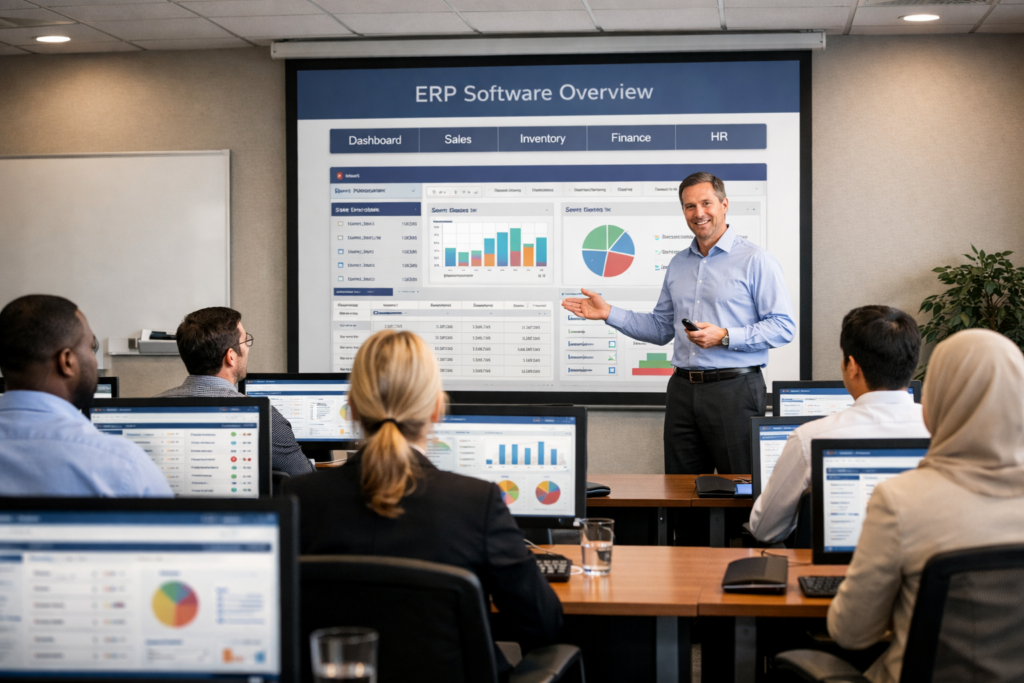
ERP success is not only technical – it is also human. Employees must be comfortable using the system.
A good partner will provide:
- Role-based training sessions
- User manuals and documentation
- Change management strategies
- Ongoing support
Without proper training, even the best ERP system will fail due to low adoption.
9. Consider Post-Implementation Support

ERP implementation does not end at go-live. Continuous support is critical for stability and growth.
Check if the partner offers:
- Maintenance contracts
- System updates and upgrades
- Bug fixes and performance monitoring
- Dedicated support channels
A long-term partnership is more valuable than a one-time implementation.
10. Compare Cost vs Value – Not Just Price
Choosing the cheapest partner can be expensive in the long run. Instead of focusing only on price, evaluate value.
Consider:
- Expertise
- Reliability
- Support quality
- Scalability
- Security standards
A slightly higher upfront investment can save significant time and money later.
11. Evaluate Cultural and Strategic Fit
Your ERP partner becomes an extension of your team for several months or years. Their working style, ethics, and vision should align with your organisation.
A partner who understands your business culture will collaborate more effectively and deliver better results.
Common Mistakes to Avoid
- Selecting a partner solely based on low cost
- Ignoring industry experience
- Skipping reference checks
- Underestimating training needs
- Choosing excessive customization
- Not planning for post-go-live support
Final Thoughts

An ERP system can transform how your business operates – but only when implemented correctly. The right ERP implementation partner acts as a strategic advisor, technical expert, and long-term supporter. Take time to research, ask detailed questions, and evaluate multiple partners before making a decision.
A well-chosen partner ensures smoother deployment, better user adoption, improved efficiency, and a stronger return on investment. In the long run, the right partnership doesn’t just implement software – it drives business growth and digital transformation.
FAQs
Question: What questions do ERP partners ask?
Answer: Industry experience? Methodology? References? Post-support? TCO breakdown?
Question: Red flags when selecting an ERP partner?
Answer: No certifications, vague process, low-price focus, poor communication.
Question: ERP partner vs DIY implementation?
Answer: Partners cut failure risk 50% via expertise in phases, training, and integrations.
Question: How evaluate ERP partner value?
Answer: Case studies + references > price; check cultural fit, long-term support.